Abdication of Emperor Xian and founding of Wei
The Romance of the Three KingdomsThe Abdication of Emperor Xian and founding of Wei is the formal transfer of the throne from the Han to Cao Pi, ending the dynasty’s four-century rule and establishing Wei. The ceremony is framed as a transfer of the Mandate of Heaven, but the events leading to it expose the gulf between that public justification and the emperor’s constrained choice: he objects, refuses to appear, and yields only after Cao Cao’s officials press and threaten him. The new dynasty’s claim to legitimacy is immediately contested by Xuande, who presents himself as the continuator of the Han line.
Background and Claims of Legitimacy
The transfer follows a long collapse of Han authority. The narrative traces division and reunification across earlier dynasties before returning to the Han court’s decay: Emperor Huan favored eunuchs over distinguished officials, Emperor Ling failed to suppress them, and the Ten Imperial Attendants came to dominate the court. The resulting disorder helped fracture the empire. By the time of the abdication, the Han emperor has spent decades amid upheaval, while Cao Cao has accumulated power and control over the court.
The story repeatedly makes political authority legible through signs attributed to Heaven. Earlier, the Jade Seal found by Sun Jian bears the inscription, “Receive the Mandate of Heaven: now you will have long life and eternal prosperity.” At the Han’s end, court astrologers and senior officials interpret a phoenix, a unicorn, and a yellow dragon as signs that the mandate has left the Han and passed to Wei. These omens are not presented as neutral proof: they become part of the officials’ argument for a transfer already advanced by Cao Pi’s political ascendancy.
Hua Xin leads the delegation that carries this argument to Emperor Xian. He praises the king of Wei’s virtue and invokes the precedent of Yao and Shun, ancient rulers said to have handed power to successors rather than favoring their own descendants. In this formulation, abdication is represented as a willing and morally elevated response to Heaven and the people. The emperor, however, rejects the premise that his inherited authority has been shown to deserve surrender. He recalls that the Han founder overcame Qin and Chu and established a dynasty passed down through the Liu family for four hundred years; he asks what wrong he has committed to forfeit what his ancestors transmitted.
Resistance and Coercion
When Emperor Xian first cannot accept the demand, Hua Xin’s party brings forward astrologers to restate the portents as evidence that Heaven has transferred its mandate. The emperor dismisses their interpretation. Wang Lang then argues that dynasties and families inevitably end and warns him to yield gracefully. Rather than consent, the emperor walks out, leaving the officials to confer among themselves.
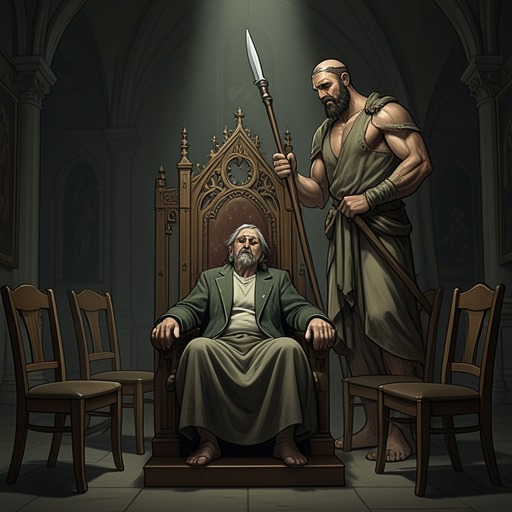
The next day the officials return and send for him. Emperor Xian initially refuses to attend, with the support of his empress, Cao Cao’s daughter. Her uncle eventually persuades him to go to the Formal Hall, where Hua Xin again insists that he comply and warns of the consequences if he does not. The emperor challenges the officials’ disloyalty, asking how men whose families benefited from serving the Han can contemplate such an act. Hua Xin answers that the emperor has lost Heaven’s favor and owes his survival to Cao Cao’s protection.
The confrontation makes the imbalance of power unmistakable. When Emperor Xian rises in anger and fear, Hua Xin seizes his dragon robe and demands an immediate answer. The keeper of the regalia, Zu Bi, refuses to hand over the imperial seal and is taken away and killed. His fate demonstrates that the ceremony’s language of orderly, voluntary succession is backed by force. The emperor’s authority is not simply transferred through shared agreement; the officials control the setting, the demand, and the consequences of refusal.
Abdication and the Founding of Wei
Faced with the assembled soldiers and officials, Emperor Xian finally says that he will surrender the throne to the king of Wei and asks to be left alive for the remaining years allotted to him by Heaven. Hua Xin assures him that he will not be harmed and calls for an official abdication announcement. The statement, hastily written in the emperor’s name, claims that after thirty-two years of rule the Han fire has ended and fortune has moved to the Cao family. It presents the transfer as following Yao’s example and declares that the empire belongs to everyone rather than to any single house.
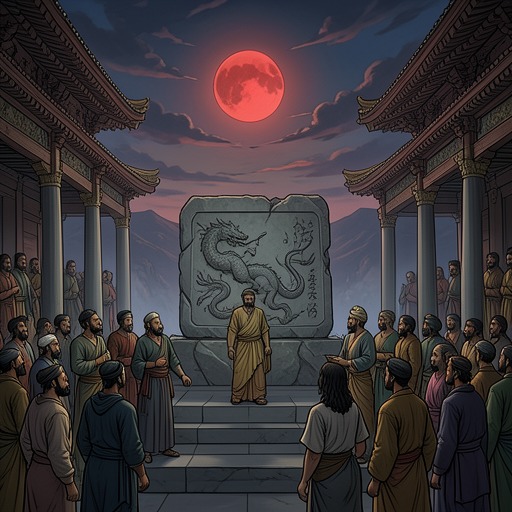
Cao Pi receives the announcement with satisfaction, but Sima Yi advises him not to accept at once. He persuades Cao Pi to refuse the offer initially and to refuse again when Emperor Xian makes a further appeal based on historical precedent. Sima Yi then arranges for the emperor to order an Altar of Abdication, where the transfer can be made in a public, formal ceremony. The pauses and staged refusals preserve the appearance of reluctance, even as the preceding pressure has made the outcome clear.
Before a large gathering of officials and soldiers, Emperor Xian hands over the jade seal of authority. Cao Pi accepts it and begins his reign as emperor of Wei. The former emperor is demoted to governor of Shanyang and ordered to leave immediately. Thus the narrative distinguishes the ritual act that completes the transfer from the political process that has compelled it: the seal changes hands in public, but the emperor’s earlier objections remain part of the meaning of the ceremony.
Portents, Aftermath, and Rival Succession
The new emperor’s first attempt to worship Heaven and Earth is interrupted by a violent storm. Winds scatter dust and stones, the sky darkens, and the ritual lanterns are blown over. Cao Pi is frightened and collapses, and afterward remains unable to act for several days. The narrative treats the storm as a portent of Heaven’s displeasure, complicating the claim that the change of dynasty has received unambiguous celestial approval. Cao Pi later believes the palace is haunted and orders a new palace built at Luoyang.
In Chengdu, news of Wei’s emergence and rumors that the former emperor has been killed distress Xuande. His illness leads him to entrust day-to-day government to Kong Ming. Kong Ming proposes that Xuande be crowned as the new Han emperor, arguing that Cao Pi has usurped the throne and that Xuande, as a descendant of the House of Liu, should continue the lineage. Xuande is initially horrified by the suggestion, calling it rebellious and disloyal; Kong Ming answers that taking the throne would instead be a duty to reclaim authority seized from the Han. The abdication therefore does not settle the question of legitimate rule. It ends the Han court’s possession of the imperial throne, establishes Wei, and gives Xuande’s rival claim a new and immediate purpose.